
Meta Ads for Hotels and Premium Brands: Costly Mistakes
Meta Ads for Hotels: 5 Costly Mistakes

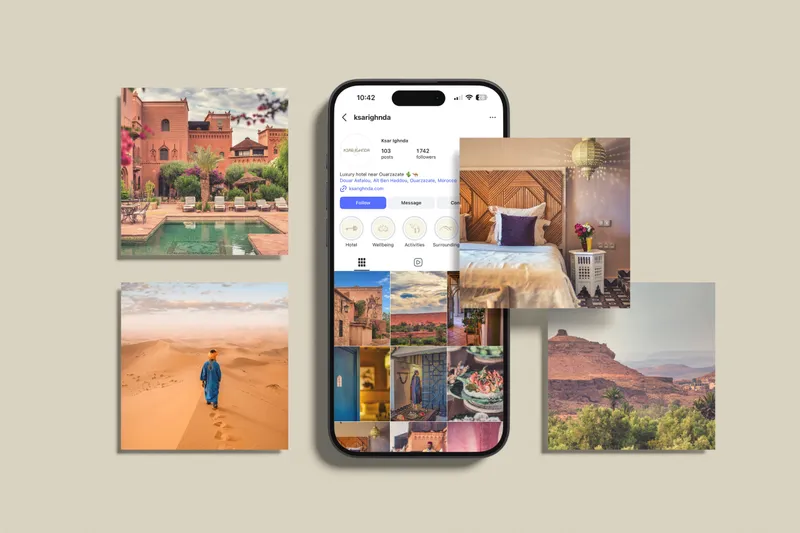




Investing in Instagram and Facebook advertising can boost a hotel’s visibility, attract new travelers, and drive direct bookings. But a poorly targeted campaign, inappropriate visuals, or sloppy tracking can quickly eat into your advertising budget. To turn Meta Ads into a powerful acquisition tool, every decision matters. Discover the most common mistakes and how to avoid them with a structured strategy. At Eliophot, our Social Ads agency supports hotels and premium brands in creating, launching, and optimizing their advertising campaigns.
Meta Ads for Hotels: A Tool for Visibility and Customer Acquisition—If Used Correctly
Facebook and Instagram play a unique role in travelers’ inspiration journey. A photo of a room overlooking the ocean, a video showcasing a spa, or a few seconds highlighting a dining experience can spark a desire to discover a property even before a stay is considered.
This is precisely the value of Meta Ads for a hotel: raising brand awareness among an audience that isn’t yet familiar with it, then sustaining their interest until a potential reservation is made.
Unlike a search conducted on a search engine, social media advertising doesn’t necessarily respond to an immediate purchase intent. It can help spark that intent.
A Meta Ads campaign for a hotel can thus serve several objectives:
-
Build brand awareness for a property or support its opening.
-
Promote a specific offer: a wellness retreat, a gourmet experience, or a romantic getaway.
-
Generate qualified traffic to the official website.
-
Encourage inquiries and direct bookings.
-
Boost the visibility of a lifestyle brand among new audiences.
However, simply running an Instagram ad for a hotel isn’t enough to drive business results. The choice of objective, the quality of the audience, the ad message, and the click destination must all work together.
A successful campaign, therefore, isn’t measured solely by the number of people reached. Above all, it must contribute to a clearly defined objective that aligns with the property’s positioning.
Mistake #1: Poorly Defined Targeting That Attracts the Wrong Visitors
One of the most common mistakes in a Meta Hotel acquisition strategy is seeking maximum visibility without considering whether the people seeing the ads are the right audience.
High traffic volume is of little value if the visitors don’t match your target audience.
Audiences that are too broad or too narrow
A hotel’s targeting strategy relies on a precise understanding of its customer base and their motivations. An urban hotel catering to business travelers will not market itself in the same way as a resort focused on leisure stays.
Geographic location, source markets, observed behaviors, and the characteristics of the existing customer base are all factors that must be analyzed before launching a campaign.
However, increasing the number of criteria does not guarantee better performance.
An audience that is too narrow can limit reach and reduce opportunities for optimization. Conversely, a broad audience without a clear strategic approach risks producing results that are difficult to interpret.
The right approach is to test different audience scopes and then analyze the results based on the campaign objective. Meta’s automated optimization solutions can also be effective, provided they are given clear objectives and high-quality signals.
For a premium hotel, the challenge isn’t simply to reach more travelers, but to meet the right expectations with a tailored offering.
Mismanaged retargeting and lookalike audiences
Retargeting for a hotel involves serving new ads to people who have already shown interest in the property, provided the necessary data and permissions are available.
This may include visitors to the official website or people who have interacted with specific content.
However, not all of these interactions indicate the same level of interest.
A user who has simply viewed a post is not at the same stage of consideration as a visitor who has explored several rooms and their availability.
Campaigns must therefore take this difference into account.
Another point to watch out for: lookalike audiences. These allow you to identify new profiles that share common characteristics with a source audience. But if the source audience is not very relevant, the lookalike audience may not align with business objectives.
To improve the quality of retargeting and lead generation, several precautions are helpful:
-
Segment audiences based on actual observed interactions.
-
Exclude people who have already converted when relevant and technically feasible.
-
Adjust the duration of the audiences to match the decision-making cycle.
-
Control exposure frequency to limit excessive repetition.
-
Verify the quality of the data used to create lookalike audiences.
The goal is not to create an excessive number of segments, but to build a clear strategy tailored to the volume of available data.
Mistake #2: Advertising campaigns that don’t sufficiently highlight the brand
In the hospitality and premium lifestyle sectors, advertising must be compelling without compromising the brand’s identity.
An ad that’s technically well-executed can lose much of its appeal if the images are generic, the message is vague, or the experience presented lacks true uniqueness.
For a high-end establishment, an elegant room is rarely a compelling enough selling point on its own. Travelers need to be able to perceive what sets the place apart: its atmosphere, architecture, surroundings, approach to service, or the experiences it offers.
Premium advertising campaigns must therefore balance aesthetics with commercial intent.
An immersive video can showcase the spaces and ambiance. A carousel can reveal multiple aspects of a stay. A carefully selected photograph can highlight a specific service.
The choice of format depends on the objective and the message to be conveyed.
Let’s take an example: a hotel looking to promote its wellness area might choose a creative focused on the experience itself rather than a simple photograph of the facilities. The ad would evoke a relaxing getaway, while the landing page would provide the necessary information to explore and book that experience.
This approach also applies to premium lifestyle brands. For a home decor, cosmetics, or jewelry brand, the advertisement must adhere to the aesthetic and editorial standards of its brand universe.
Three mistakes are particularly common:
-
Systematically reusing organic posts without adapting them to advertising objectives.
-
Running the same visual across all ad placements without checking its framing and readability.
-
Prioritizing a promotional headline at the expense of the brand’s perceived value.
Creative content must also evolve. Testing multiple taglines, visuals, or video clips helps identify the messages that generate the most interest.
Good advertising shouldn’t just catch the eye—it should give people a reason to explore further.
Mistake #3: Sending the same message at every stage of the customer journey
A hotel social media ad campaign cannot address a user who is just discovering a property in the same way as one who is already considering staying there.
That’s the whole point of a strategy organized around the funnel—in other words, the journey that gradually leads from discovery to conversion.
There are generally three main stages.
1. Discovery: Raising Awareness of the Property
At this stage, the goal is to spark interest. Creative content emphasizes the property’s identity, its unique experiences, and its positioning.
For a boutique hotel, this might involve showcasing its architecture, its spaces, or its connection to a destination.
Brand awareness campaigns are particularly effective here.
2. Consideration: Fostering the desire to stay
The traveler is now familiar with the property but wants to learn more.
A Facebook Ads campaign for a hotel can then highlight specific rooms, a spa experience, dining options, or the benefits of the location.
The message becomes more concrete and invites users to explore an offer or detailed content on the website.
3. Conversion: Facilitating the Call to Action
The prospect is showing a more advanced level of interest. The ad can now highlight availability, a relevant offer, or the terms of a direct booking—without always having to offer a discount.
Retargeting can help at this stage when technical and regulatory conditions allow it.
Be careful, however: the customer journey isn’t always linear. A traveler might discover a hotel on Instagram, search for it several days later, and book through a different channel.
This reality calls for thinking beyond the last click and considering the various touchpoints that influence the decision.
To explore this holistic approach further, check out our article on social media strategy for a hotel.
Mistake #4: Neglecting tracking and the booking journey
A campaign can have a good click-through rate while generating few reservations. The problem isn’t necessarily with the targeting or the ads.
It may also lie in what happens after the click.
In a Meta Ads strategy for hotels, measuring conversions is key. Without reliable data, it becomes difficult to understand visitor behavior and allocate investments effectively.
The Meta Pixel allows you to track certain events on a website, depending on consent settings and the chosen configuration. The Conversions API can complement this system by transmitting events from compatible systems.
However, these tools require appropriate technical and regulatory implementation. On their own, they do not guarantee comprehensive measurement.
In the hospitality industry, an additional challenge may arise when the booking engine operates on a domain separate from that of the official website.
It is therefore essential to verify that tracking remains consistent from the time a user views an offer until any subsequent booking confirmation.
Without this verification, a campaign may be evaluated based on incomplete metrics.
Another mistake: neglecting consistency between the ad and its landing page.
An ad promoting a wellness getaway should ideally lead to a page showcasing that experience, rather than to a general homepage.
Visitors must immediately find the information that prompted them to click: the offer’s details, services, terms and conditions, and the option to take action.
A seamless mobile experience, clear information, and an accessible booking engine help minimize obstacles.
Finally, ad tracking must comply with personal data regulations. Advertising trackers that require consent cannot be activated until the user has given their approval.
A campaign’s performance thus begins well before it goes live: it also depends on the quality of the digital ecosystem to which it links.
Mistake #5: Managing campaigns using the wrong KPIs
A high number of impressions, numerous interactions, or an attractive cost per click can give the impression that a campaign is performing perfectly.
However, these metrics alone aren’t enough to demonstrate a campaign’s business impact.
In a Meta Hotel acquisition strategy, it’s important to distinguish between several levels of performance.
Visibility metrics help assess ad exposure:
-
Reach: the number of people reached.
-
Impressions: the number of times ads are displayed.
-
CPM: cost per thousand impressions.
-
Frequency: the average number of exposures per person reached.
Engagement metrics provide insight into audience response:
-
CTR: click-through rate on ads.
-
CPC: average cost per click.
-
Video views and interactions.
-
Landing page visits.
Conversion metrics align with business objectives:
-
Qualified inquiries.
-
Bookings attributed to campaigns.
-
Cost per attributed booking.
-
Attributed revenue and return on ad spend, when data is available.
The customer acquisition cost for Social Ads should be interpreted with caution. It depends, in particular, on the promoted offer, the market, the season, and the attribution method.
A campaign that generates low-cost clicks is not necessarily more profitable than a campaign that attracts fewer visitors but generates more reservations.
It is also important to distinguish between conversions attributed by Meta and bookings actually recorded by the property. Attribution windows and multichannel journeys can explain certain discrepancies.
For a hotel, monitoring is therefore most effective when advertising results are compared with available sales data.
The key question is not just how much a click costs, but what that click actually contributes to the business.
How does a social media advertising agency optimize advertising budgets?
Performance doesn’t depend solely on the amount invested. It relies first and foremost on the ability to allocate the budget according to objectives and then adjust campaigns based on the results observed.
For a hotel, this approach must take into account the specific operational constraints: seasonality, booking periods, occupancy rates, priority markets, and the availability of offers.
A hotel looking to increase weekday bookings will not necessarily pursue the same goals as one seeking to boost brand awareness ahead of an opening.
The budget strategy must reflect these priorities.
A specialized agency provides a management approach structured around several steps.
First, an audit examines existing campaigns, target audiences, ad creatives, and measurement tools. It helps identify pain points and opportunities for improvement.
Next comes the definition of objectives. Brand awareness, qualified traffic, inquiries, and reservations do not always require the same campaign parameters.
The rollout phase relies on messages and creative tailored to the selected audiences. Initial results are used to test hypotheses and identify opportunities for optimization.
Finally, regular monitoring allows for informed investment decisions.
This may involve reallocating part of the budget to a more relevant audience, refreshing a creative that’s losing traction, or revising an ad’s landing page.
The challenge also lies in avoiding constant changes that prevent accurate performance evaluation.
In the premium hospitality sector, this approach must strike an additional balance: driving commercial results while upholding the brand’s value and positioning.
An effective advertising strategy isn’t necessarily one that relies on a barrage of promotions. It must highlight a property’s unique selling points and inspire people to book for the right reasons.
Why entrust your Meta Ads campaigns to Eliophot?
Specializing in the hospitality industry and premium and luxury lifestyle brands, Eliophot combines advertising expertise, an understanding of customer journeys, and creative insight to build campaigns that align with each brand’s goals.
Our approach goes beyond simply setting up ads. It draws on several complementary skills: audience targeting, visual content creation, message development, campaign deployment, and results analysis.
This cross-functional approach allows us to address the strategic, creative, and technical aspects of social ads simultaneously.
We support hotels and brands in their advertising decisions by taking into account their identity, business objectives, and operational constraints.
Because a Meta Ads campaign for a hotel should never be merely an expense for visibility, we advocate an approach where every investment is part of a coherent, measurable, and scalable communication strategy.
Do you want to increase your visibility, attract a more targeted audience, and get more value out of your advertising investments?
Schedule a meeting with the Eliophot teams to discuss your Meta Ads campaigns and build a social media advertising strategy tailored to your property or brand.
Eliophot,
your 360° agency